


Alberta Curriculum
CIS’ curriculum follows the Alberta Program of Studies. Alberta’s Kindergarten to Grade 12 curriculum is designed to help students achieve their individual potential and create a positive future. The provincial programs of study identify what students are expected to learn and do in all subjects and grades. For more information on our curriculum, please visit the Alberta Education website using the following link here.
Student-centered learning is an international educational initiative developing in response to our 21st Century global demands for highly skilled and self-directed thinkers. Training students to be problem solvers means providing them with situations that incorporate cross-curricular competencies; which is why Alberta Education promotes Inquiry-Based Learning (IBL), a “process where students are involved in their learning, formulate questions, investigate widely and then build new understandings, meanings and knowledge” (Focus on Inquiry, 2004, p.1). For more information regarding the Alberta Curriculum, please visit the Alberta Parent Resource Website, My Child’s Learning. For specific information outlining Alberta Diploma requirements, or other educational guidelines set out by Alberta Education, see the Alberta Guide to Education.
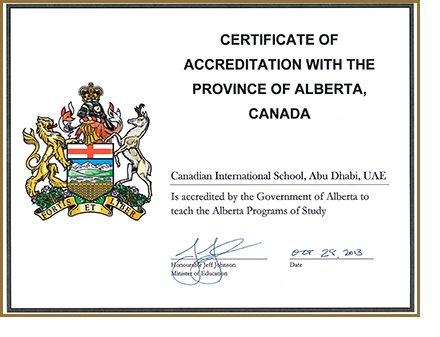

Students in grades 3, 6, and 9 take provincial achievement tests to evaluate grade-level standards and expectations, and Grade 12 students write provincial examinations in core subject areas to qualify for an Alberta High School Diploma. CIS grants Alberta high school diplomas to students based on a credit system. To complete senior high, students must be awarded 100 credits. Students are awarded credits for each course they complete with satisfactory results. In addition, Grade 12 students must write and pass diploma examinations in core subject areas to graduate. Diploma examinations are provincially administered and account for 30 percent of the students’ final grade in the course. This internationally recognized diploma permits students’ entry into university programs throughout North America and the world.
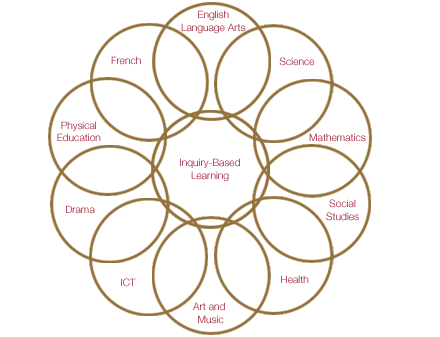
Alberta Program Subjects : English Language Arts, Mathematics, Science, English Social Studies, Physical Education, Art and Music, Health, Drama, Information and Communication Technology (ICT) and French.
UAE Requirements : Arabic, Islamic Studies and Arabic Social Studies are taught in accordance to the UAE Ministry of Education specifications.
Inquiry Based Learning
Also known as Problem-based learning or Project-based learning or PBL, Inquiry-Based Learning is an approach that has proven to increase students’ abilities to problem-solve using a student-centered delivery of instruction. While nothing can replace the time needed for systematic math and language skill acquisition, learning opportunities to apply these skills are critical for developing problem solving skills. In IBL, a “problem” or question is presented and students must use their prior knowledge and skills to build direct and meaningful correlations to solve the problem. Math, English, Social Studies, Science, Information and Communication Technology, Fine Arts are explored in combination or simultaneously in real life contexts. Through questions and questioning, teachers and students match project objectives with the Alberta Education’s Specific Learner Expectations.
Projects bring a whole new enthusiasm to the classroom. The scope and breadth of projects can vary from days to weeks to months. Because students are engaged in projects that are “real” to them – about the real world, their world – their level of concentration and application increase, as do their learning results. Students learn best when they are actively engaged in activities that are important and meaningful to them. Accomplishing a task independently constitutes learning.
Authentic Assessment, or Performance Assessment, refers to evaluating students throughout the whole learning process and not just at the end of a unit or semester. Students and teachers benefit from these frequent assessment opportunities because strengths and weaknesses are identified prior to the “final exam.”